


What Should First-Time Buyers Know About Purchasing a Used Electric Vehicle?
Buyers purchasing a pre-owned electric vehicle need to evaluate battery health, remaining factory battery warranty coverage, charging history, and included charging hardware before completing a purchase. Unlike gas-powered vehicles where engine compression and mechanical transmission wear dictate longevity, an electric vehicle’s value and long-term usability depend on its high-voltage battery capacity and electronic management systems.
When transitioning to electric driving, understanding how a pre-owned EV fits your lifestyle requires looking closely at daily driving distances and home charging setups. Most modern electric vehicles deliver substantial real-world range, making them ideal for daily suburban commutes across Aurora or extended highway travel. When evaluating pre-owned models, inspecting the battery condition and confirming that the vehicle’s onboard AC charger matches your intended home wallbox installation ensures a seamless ownership experience.
Our team at John Elway Cadillac of Park Meadows guides shoppers through every diagnostic detail, verifying that software updates are current and that all high-voltage thermal systems function to factory standards. You can reach out to our team at (303) 799-1110 or visit our showroom address to compare pre-o wned electric options in person.
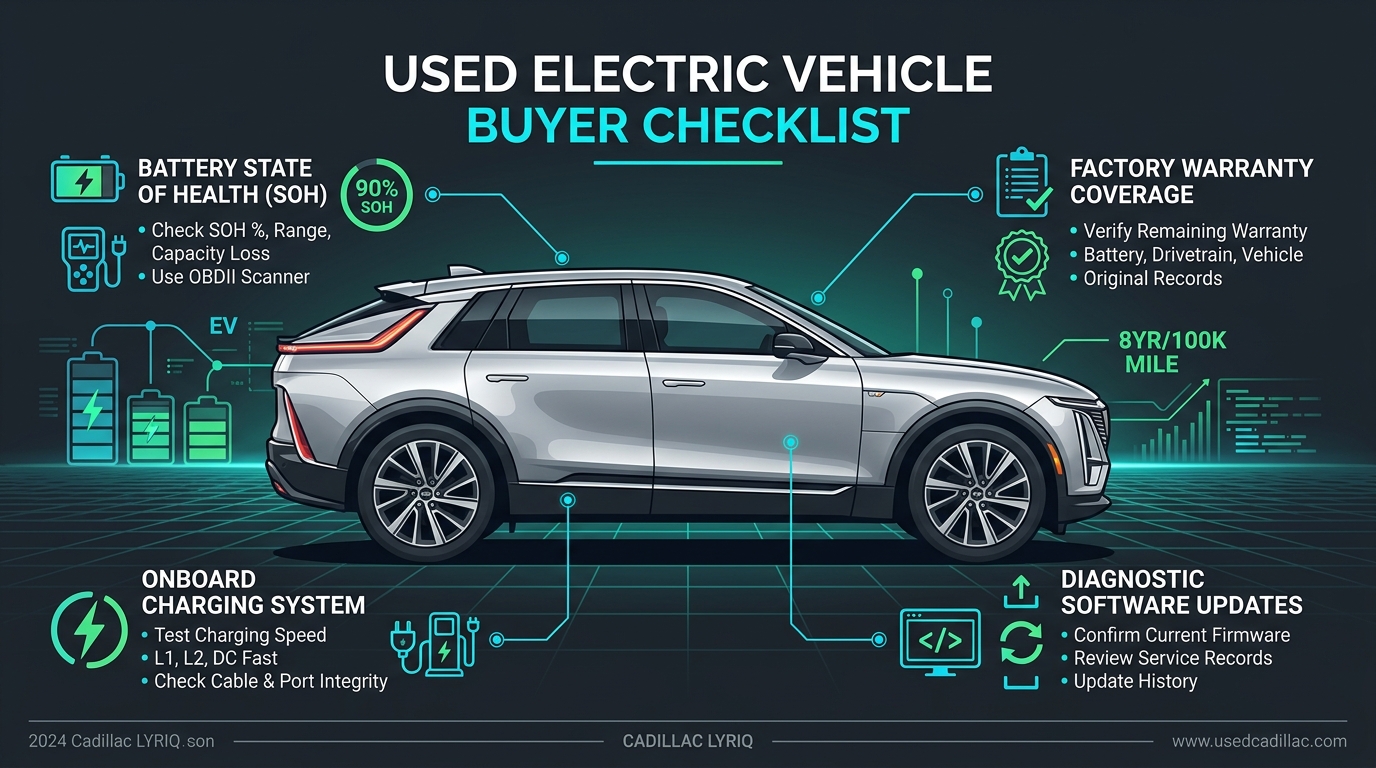
Table of Contents
- How Is Shopping for a Used EV Different Than Shopping for a New EV?
- How Do You Check Battery State of Health and Diagnostic Data on a Used EV?
- At What Age Do Used Electric Vehicles Deliver the Best Value Relative to New Models?
- What Warranty Coverage and Charging Cables Come with a Certified Pre-Owned EV?
- What Step-by-Step Approach Should First-Time Used EV Buyers Follow?
- Common Questions First-Time Buyers Ask About Used Luxury Electric Vehicles
- Finding Your Ideal Used Luxury EV
How Is Shopping for a Used EV Different Than Shopping for a New EV?
Unlike new models, used electric vehicles require careful assessment of battery degradation and charging history to ensure long-term reliability. While a new electric model guarantees 100% battery State of Health and a full factory warranty, a pre-owned EV offers lower purchase costs and reduced initial depreciation in exchange for moderate battery aging.
Evaluating a pre-owned electric vehicle requires reviewing diagnostic data to determine how the previous owner maintained the battery. Vehicles that primarily charged overnight on a slower Level 2 home charger experience less thermal stress than vehicles heavily reliant on high-output DC fast chargers. Fast charging generates internal cell heat, which can accelerate capacity loss over extended periods.
Another key difference involves federal incentives and warranty transfers. Historical federal tax credits for clean vehicles were terminated for acquisitions after September 30, 2025 under Public Law 119-21, meaning pre-owned EV shoppers today focus on direct market value and lingering factory protection. Most manufacturers back electric drivetrains with an 8-year/100,000-mile high-voltage battery warranty that transfers to subsequent owners. Confirming the remaining years and mileage cap on that coverage provides strong financial protection.
Shoppers browsing our pre-owned vehicle inventory will find fully documented luxury EVs that have undergone thorough electrical inspections. Comparing pre-owned models against new arrivals allows you to balance upfront savings with the latest technology upgrades.
How Do You Check Battery State of Health and Diagnostic Data on a Used EV?
Checking battery health on a pre-owned electric vehicle requires pulling a diagnostic State of Health percentage report, examining the displayed range at full charge, and checking for cell voltage uniformity across the high-voltage pack. The State of Health percentage measures current usable battery capacity against its original factory spec when brand new.
To evaluate battery condition during a viewing or test drive, consider these primary diagnostic methods:
- Dashboard Battery Menu: Many modern EVs feature onboard energy menus or companion apps that display overall battery health scores or remaining capacity bars.
- Full-Charge Range Check: Charging the battery to 100% state of charge and comparing the displayed estimated miles against the vehicle’s original EPA rating provides an immediate estimate of capacity retention.
- OBD-II Diagnostic Scan: Plugging a specialized diagnostic scanner into the OBD-II port allows technicians to read individual cell voltages, total battery throughput, and historical temperature logs directly from the battery management system.
A well-maintained electric vehicle that is five to eight years old typically retains between 80% and 90% of its original usable range. Liquid-cooled battery packs maintain capacity significantly better over time than older air-cooled designs because active thermal management protects cells from extreme summer heat and harsh freezing temperatures.
Local climate conditions also influence day-to-day driving numbers. During severe Colorado winter weather, temporary range loss between 15% and 30% is normal due to chemical slowdown inside lithium-ion cells and cabin heating demands. Using garaged parking, scheduling cabin preconditioning while plugged in, and equipping snow-rated tires help mitigate seasonal efficiency drops.
At What Age Do Used Electric Vehicles Deliver the Best Value Relative to New Models?
Pre-owned electric vehicles generally deliver their strongest value proposition between two and five years of age, where initial depreciation has flattened out while significant factory battery warranty coverage remains intact. Vehicles in this age bracket offer modern infotainment tech, advanced driver-assist features, and generous driving range at a fraction of their original MSRP.
Within the two-to-five-year window, high-voltage battery packs retain the vast majority of their original range, while second owners still benefit from several years of remaining 8-year/100,000-mile factory battery protection. By contrast, brand-new models carry premium pricing reflect original manufacturing costs and flagship technology releases.
For comparison, a new flagship model like the 2026 Cadillac VISTIQ carries a starting MSRP of $77,395, offering standard all-wheel drive, 7 passenger seating, and a tow rating of 5,000 lbs. Comparing a brand-new luxury EV to a late-model pre-owned alternative highlights the tradeoff between owning the newest architecture and maximizing immediate purchase value.
Shoppers interested in comparing model generations can explore our current new luxury inventory to evaluate fresh factory tech alongside pre-owned options. If you plan to upgrade from your current vehicle, our team can help you value your trade-in to apply its equity directly toward your purchase.
What Warranty Coverage and Charging Cables Come with a Certified Pre-Owned EV?
Certified Pre-Owned electric vehicles combine remaining original factory warranties with specialized CPO coverage extensions while including verified high-voltage components and charging equipment. Manufacturer CPO programs typically extend bumper-to-bumper warranty protection by 1 to 2 years beyond the original limits while retaining the balance of the original 8-year/100,000-mile high-voltage battery warranty.
When purchasing any pre-owned electric vehicle, confirming the inclusion of portable charging equipment is essential:
- Level 1 Charging Cord: Standard 120-volt portable cables plug into conventional household outlets, delivering roughly 3 to 5 miles of range per hour of charging.
- Level 2 Dual-Voltage Cord: Upgraded 240-volt portable charging sets allow faster charging when connected to NEMA 14-50 outlets, providing up to 25 miles of range per hour.
- Public Charging Adapters: Vehicles equipped with specific charging inlet designs may include factory adapters for broader compatibility across public DC fast-charging networks.
Not all pre-owned EVs arrive with original charging cables in the trunk, as previous owners occasionally retain portable cords for home use. Verifying equipment presence during inspection prevents unexpected out-of-pocket accessory expenses after delivery.
Onboard AC charging hardware also dictates home replenishment speeds. Premium electric SUVs feature powerful onboard AC chargers capable of accepting up to 19.2 kW from a dedicated Level 2 wallbox, enabling rapid overnight charging even on large-capacity battery packs.
What Step-by-Step Approach Should First-Time Used EV Buyers Follow?
A systematic approach involving home charger setup, battery health checks, and thorough vehicle history review helps first-time buyers confidently select a used EV.
- Confirm Home Charging Setup: Assess your home parking situation to determine if you can install a dedicated 240-volt Level 2 charger. Homeowners with private garages on spacious properties near Foxfield find overnight charging seamless, whereas apartment residents must verify nearby public or workplace charging access.
- Establish Realistic Range Needs: Calculate your daily commute distance and typical weekend travel patterns to identify minimum acceptable battery capacity, factoring in cold-weather range margins.
- Inspect Battery Health Records: Request a certified diagnostic State of Health printout showing remaining battery capacity and cell balance. Confirm that all manufacturer safety recalls and battery control software updates have been completed.
- Verify Warranty Transfer and Accessories: Check the vehicle’s VIN with the manufacturer to confirm remaining 8-year/100,000-mile battery coverage terms. Inspect the trunk for included Level 1 or Level 2 charging cables and adapter hardware.
- Conduct a Targeted Test Drive: Test all drive modes and adjust regenerative braking settings. Pay attention to cabin quietness, suspension damping over road imperfections, and screen responsiveness across climate and energy management menus.
Shoppers looking at pre-owned luxury EVs often inspect the battery health display and remaining warranty terms on their very first walk-around before discussing finance options. Once you select the ideal model, you can submit an online credit application to streamline your showroom visit.
Common Questions First-Time Buyers Ask About Used Luxury Electric Vehicles
Q: How do I know if the remaining battery warranty transfers to me when buying a used EV?
High-voltage battery warranties on electric vehicles are attached to the vehicle identification number (VIN) rather than the original purchaser. Most major luxury manufacturers automatically transfer the remaining balance of the 8-year/100,000-mile battery and drivetrain warranty to subsequent owners. To verify active coverage, provide the vehicle VIN to our dealership team or the vehicle manufacturer to confirm original in-service dates and remaining mileage allowances.
Q: Will cold winter weather permanently damage a used EV battery?
Cold winter temperatures temporarily reduce chemical efficiency inside lithium-ion cells, causing a seasonal range drop between 15% and 30%, but cold weather does not permanently damage the battery pack. Modern electric vehicles utilize active liquid thermal management systems that circulate coolant to heat or chill the battery to safe operating temperatures. Parking inside a garage and preconditioning the vehicle while connected to a charger preserves battery health during freeze cycles.
Q: Do used electric vehicles require special auto insurance coverage?
Pre-owned electric vehicles are insured under standard automotive policies, though premiums reflect replacement values, specialized aluminum body structures, and high-voltage electronics. Insurance coverage operates under identical principles as gas vehicles. It is advisable to obtain a quote using the specific VIN before purchasing to confirm premium rates and verify that home charging station hardware attached to your residence is included in your property or comprehensive policy details.
Q: Is a Level 2 home charger required, or can I rely on standard wall outlets?
While a standard 120-volt Level 1 outlet can replenish 30 to 40 miles of range during an overnight plug-in, installing a dedicated 240-volt Level 2 home charger provides far greater convenience. A Level 2 station fully recharges most battery packs overnight, allowing drivers to start every morning with 100% available capacity. Drivers with daily commutes under 30 miles can manage short term on Level 1, but Level 2 hardware is recommended for long-term ownership.
Q: How quickly does DC fast charging replenish range on a pre-owned luxury EV?
DC fast-charging speeds depend on vehicle architecture, peak kilowatts supported, and current battery temperature. High-voltage platforms supporting 800-volt charging architecture can replenish 10% to 80% battery capacity in approximately 20 to 30 minutes at compatible high-output stations. Charging speeds automatically taper off past 80% capacity to protect internal cell health and prevent excessive heat buildup.
Finding Your Ideal Used Luxury EV
Purchasing a pre-owned electric vehicle offers an excellent combination of luxury, advanced technology, and low operating costs when guided by thorough battery health verification and warranty confirmation. Evaluating battery State of Health, confirming charging hardware, and securing remaining factory coverage ensures long-term driving satisfaction.
Our team is ready to walk you through diagnostic reports, demonstrate onboard charging features, and assist with trade-in appraisals. Stop by our Lone Tree showroom or give our sales team a call at (303) 799-1110 to explore our current pre-owned electric inventory today.
Keep Your Vehicle Running Strong
Keep your vehicle performing at its best with our service team:
0 comment(s) so far on What Should First-Time Buyers Know About Purchasing a Used Electric Vehicle?