


How Do You Evaluate Battery Health on a Used Cadillac EV?
Evaluating battery health on a used Cadillac EV requires a specialized diagnostic scan of the battery management system to pull total state-of-health percentage, individual cell-voltage balance, historical charging cycles, and diagnostic fault codes. Combined with verifying the original in-service date and remaining factory warranty coverage, these diagnostic reports provide a precise measurement of usable capacity retention before purchase or ongoing service.
A high-voltage battery diagnostic scan goes far deeper than the basic state-of-charge percentage visible on the instrument cluster display. While the dashboard gauge indicates how much energy is currently stored in the battery pack, a professional diagnostic tool interfaces directly with the central battery management controller to measure maximum energy storage capacity against factory-new parameters. This process quantifies operational capacity loss and highlights any electronic anomalies across the energy storage system.
Physical and environmental factors also reveal critical details about battery health. Technicians evaluate the thermal management cooling circuit, inspecting coolant levels, pump operation, and heat exchanger condition to ensure the pack can maintain optimal operating temperatures. Suburban commuters in Aurora driving along high-speed corridors like I-225 depend heavily on a properly cooled battery to handle rapid power draws and high-voltage DC fast charging without accelerating thermal wear.
Verifying full service records and software updates confirms whether the high-voltage system has received all factory-recommended maintenance and module calibrations. For drivers evaluating pre-owned luxury electric vehicles, our certified technicians perform complete multi-point high-voltage battery inspections at our Lone Tree service facility. If you have questions about scheduling a pre-purchase diagnostic check, feel free to give our service team a quick call to discuss our testing process.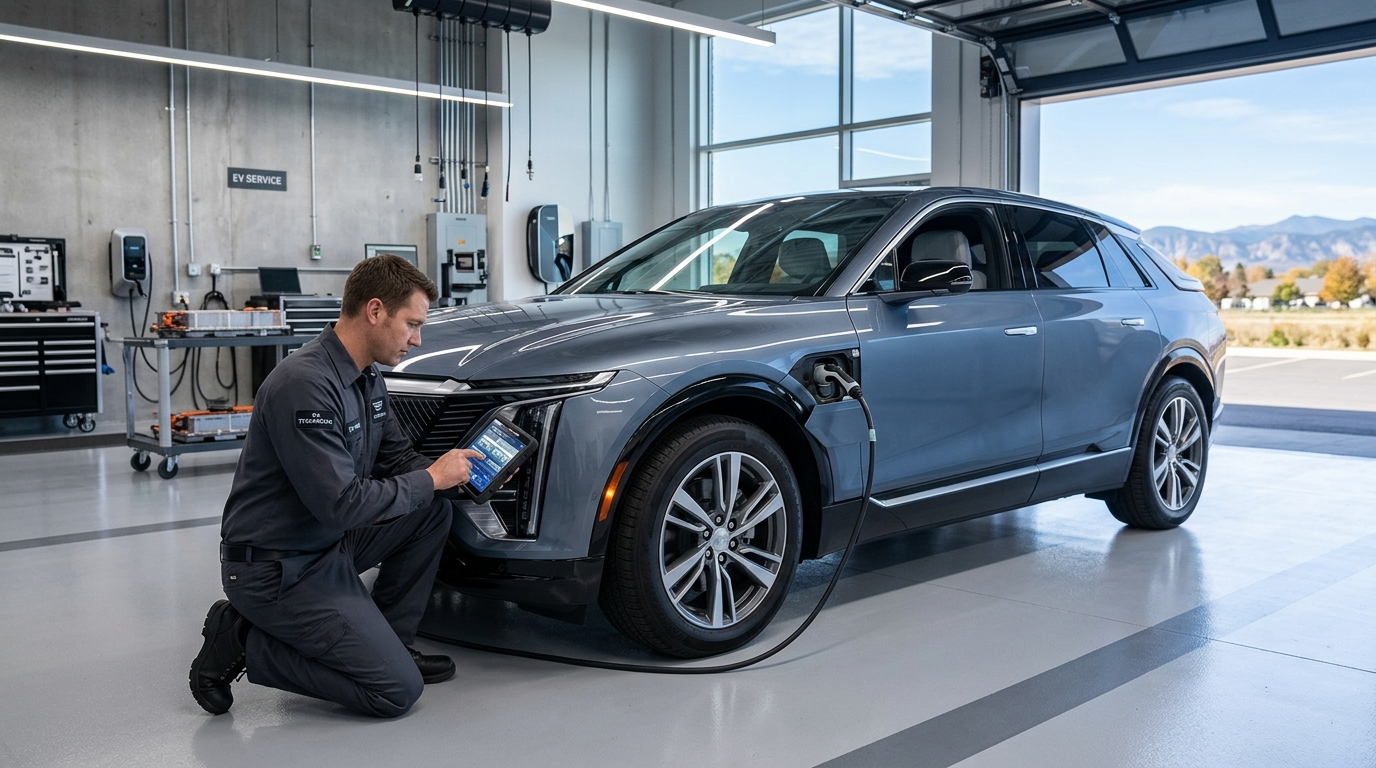
Table of Contents
- How Do You Check Ultium Battery State of Health on a Used Cadillac LYRIQ?
- What Happens If an Ultium Wireless Battery Module Sensor Fails?
- How Much Battery Warranty Protection Remains and What Triggers a Claim?
- What Is the Range Retention of the Cadillac LYRIQ and How Does Cold Weather Impact It?
- Quick Answers to Common Questions About Used Cadillac EV Battery Care
How Do You Check Ultium Battery State of Health on a Used Cadillac LYRIQ?
Checking the Ultium battery state of health on a pre-owned Cadillac LYRIQ involves querying the battery management system via high-level diagnostic equipment to read cell-level telemetry and total battery capacity percentage. This process reveals voltage discrepancies across individual pouch cells and measures actual pack energy storage against the original 102 kWh usable factory specification.
Vehicle owners and prospective buyers have several methods available to inspect battery condition, ranging from convenient connected services to in-depth dealer diagnostics:
- OnStar Vehicle Diagnostic Reports: Connected vehicle services deliver periodic monthly summaries indicating high-voltage system status, active diagnostic trouble codes, and overall battery state of charge.
- In-Vehicle Infotainment Diagnostic Displays: Native charging and energy menus provide real-world efficiency figures, energy usage trends, and charging history metrics directly on the 33-inch LED display screen.
- Third-Party OBD-II Diagnostics: Specialized EV telemetry tools and compatible dongles interface with the vehicle controller area network (CAN bus) to estimate battery State of Health ( SOH) percentages and monitor cell balance.
- Factory GDS2 Diagnostic Scans: Authorized dealer diagnostics utilize factory software to query every module, providing definitive cell-by-cell voltage mapping and factory-verified state-of-health data.
A comprehensive dealer scan delivers a high level of accuracy by reading telemetry directly from the Ultium energy architecture. The test checks whether individual cell voltages remain tightly balanced within precise millivolt thresholds under load. Significant voltage variations between cells indicate potential weak points or faulty monitoring electronics within specific module trays.
Regular diagnostic evaluation helps maintain peak vehicle range, optimal charging efficiency, and long-term reliability. Should diagnostic scans indicate a need for replacement sensors, wiring components, or thermal management fluids, our Cadillac parts department maintains genuine factory-engineered components designed specifically for high-voltage platform service.
What Happens If an Ultium Wireless Battery Module Sensor Fails?
If a wireless battery management system sensor fails inside an Ultium battery module, the central battery management controller logs a diagnostic fault code, illuminates a driver warning indicator, and automatically safeguards or isolates the affected module while maintaining normal vehicle propulsion.
General Motors engineered the Ultium architecture with a ground-breaking wireless battery management system ( wBMS), which eliminates up to 90 percent of traditional high-voltage wiring harnesses inside the pack. Small, localized wireless monitoring nodes are positioned on each module’s circuit board to measure cell voltages and module temperatures constantly. When one of these wireless sensor nodes experiences a hardware failure, signal loss, or internal communication fault, the central battery management host immediately detects the disruption.
Upon detecting a sensor communication drop or out-of-spec reading, the controller initiates protective protocols:
- Fault Logging: The system records specific diagnostic trouble codes ( DTCs) pinpointing the exact module address and sensor identification number.
- Driver Notification: A service vehicle light or propulsion power message displays on the driver instrument panel to signal that high-voltage service is required.
- Module Safeguarding: The battery host controller adjusts energy draw parameters to isolate or limit the power throughput of that specific module tray, preventing thermal stress or voltage imbalance.
- Fail-Safe Operation: The vehicle maintains drivability at safe operating levels, allowing the driver to reach an authorized service center without sudden loss of vehicle power.
The modular design of the Ultium platform provides a distinct repair advantage when a sensor failure occurs. Rather than forcing the total replacement of a costly high-voltage battery assembly, factory-trained technicians can open the battery enclosure, service or replace the individual wireless module board or tray, and recalibrate the wBMS network using specialized diagnostic tools.
How Much Battery Warranty Protection Remains and What Triggers a Claim?
Cadillac provides an 8-year or 100,000-mile limited warranty on high-voltage battery components, with remaining coverage determined by calculating the time and mileage accrued since the original vehicle in-service date. A warranty replacement claim is officially triggered when factory diagnostic testing verifies permanent usable capacity degradation exceeding 30 percent from the original rated capacity.
Understanding how factory warranty coverage applies to a used luxury EV requires reviewing the specific component tiers established by the manufacturer:
- Bumper-to-Bumper Limited Warranty: Covers general vehicle components, electronics, onboard AC chargers, and thermal management pumps for 4 years or 50,000 miles.
- Powertrain Limited Warranty: Protects electric drive units, reduction gearboxes, and electric motors for 6 years or 70,000 miles.
- EV Specific / Battery Limited Warranty: Encompasses the high-voltage battery pack, power electronics inverter, DC-DC converter, and high-voltage wiring for 8 years or 100,000 miles.
To calculate remaining warranty protection on a pre-owned model, check the initial delivery date registered in the vehicle history report. Because Cadillac factory warranties transfer automatically to subsequent owners at no additional cost, a secondary buyer purchasing a three-year-old vehicle with 30,000 miles retains approximately five years and 70,000 miles of high-voltage battery coverage.
A warranty replacement claim requires rigorous verification by an authorized service department. Gradual, normal capacity reduction—such as a battery retaining 85 to 90 percent capacity after several years—is considered standard operational behavior. However, if factory diagnostic software confirms that permanent usable energy retention has fallen below the 70 percent threshold (a 30 percent or greater loss), Cadillac replaces or repairs internal battery modules under warranty to restore capacity above the required specification.
What Is the Range Retention of the Cadillac LYRIQ and How Does Cold Weather Impact It?
Under standard operating conditions, the Cadillac LYRIQ retains high battery capacity over time with expected annual degradation averaging just 1 to 2 percent, while cold winter weather temporarily reduces real-world driving range by 15 to 30 percent due to lithium-ion electrochemical slowdowns and cabin heating demands.
When new, the Cadillac LYRIQ utilizes a 102 kWh usable capacity battery pack to deliver an EPA-estimated range of up to 314 miles in rear-wheel-drive models and 307 miles in all-wheel-drive configurations. Field data across modern NMC (nickel manganese cobalt) chemistry packs demonstrates that properly managed batteries experience minimal long-term capacity degradation when daily charging limits are kept between 80 and 90 percent.
Seasonal range fluctuation is fundamentally different from permanent capacity loss. Sub-freezing Front Range winters temporarily slow chemical reactions within battery cells and increase internal resistance. When owners bring a pre-owned LYRIQ into our service bay after their first snowfall, they often ask if a sudden drop in displayed range on sub-freezing mornings indicates battery damage, but this temporary reduction reflects cabin heat draw and battery temperature rather than permanent pack wear.
Rural property owners in Foxfield charging in unheated detached garages benefit from setting preconditioning schedules before morning drives. Preconditioning uses grid power while plugged into a Level 2 home charger to warm both the battery pack and cabin before departure. Pre-warming the high-voltage system reduces the power drain required during initial acceleration, recovering a substantial portion of the range temporarily lost to cold temperatures.
Quick Answers to Common Questions About Used Cadillac EV Battery Care
Q: What does an OnStar EV battery health report show?
An OnStar EV report provides a high-level summary of total vehicle mileage, remaining high-voltage battery charge percentage, estimated driving range, and active diagnostic trouble codes related to the electrical architecture. While convenient for quick monthly checks, an OnStar report does not detail individual cell voltage balances or perform the deep capacity testing available during a factory service diagnostic scan.
Q: Can an independent auto shop read Ultium battery state of health?
While basic OBD-II scan tools can read standard powertrain codes, reading cell-by-cell telemetry, rebalancing battery module voltages, or updating controller software on the Ultium platform requires specialized GM GDS2 factory software and certified high-voltage safety tools. Independent shops without specialized EV software cannot execute complete battery health validations.
Q: Does frequent DC fast charging damage a used Cadillac EV battery?
Frequent DC fast charging creates elevated thermal conditions inside high-voltage packs, which can slightly accelerate wear compared to standard Level 2 charging over several years. However, Cadillac’s active liquid thermal management system actively circulates coolant during high-rate charging to keep cell temperatures within safe parameters, preserving pack health under normal usage patterns.
Q: Are individual battery modules replaceable if a single cell fails?
Yes, the modular architecture of the Ultium battery system allows factory-trained technicians to remove the battery pack enclosure and replace individual module trays or electronic control boards. Servicing targeted components rather than replacing the complete high-voltage battery assembly significantly lowers out-of-warranty repair costs.
Q: What routine service keeps a pre-owned Cadillac LYRIQ battery healthy?
Key maintenance practices include replacing high-voltage cooling system fluid at factory-specified intervals, keeping the battery management system updated with the latest manufacturer software, and maintaining daily charging habits between 20 and 80 percent state of charge to minimize chemical stress on the battery cells.
To ensure your luxury electric vehicle continues operating at peak efficiency, trust our factory-trained service technicians at our Lone Tree service facility for all your diagnostic, maintenance, and high-voltage care needs. Contact our knowledgeable advisors by calling (303) 799-1110 or secure your preferred appointment slot by scheduling an EV battery inspection online today.
© 2026 John Elway Cadillac of Park Meadows. All rights reserved.
0 comment(s) so far on How Do You Evaluate Battery Health on a Used Cadillac EV?